The question – what does Done Look Like? – was asked every week on the program that changed my life as a Program Manager. Rocky Flats Environmental Technology Site (RFETS) was the marketing term for the 3rd-worst toxic-waste site on the planet. RFETS was a nuclear bomb manufacturing plant, built in 1951, operating until 1989, and closed in 2005. I served as VP of Program Management for the ITC (Information Technology and Communications) group, providing ERP, purpose-built IT, voice, and data systems for 5,000 employees and contractors at the Bomb Factory. [1]
Knowing what Done looks like is one of five principles of project success
- What does Done look like?
- What is the path to Done?
- Do we have enough time, resources, and money to reach Done as planned?
- What impediments will we encounter on the way to Done?
- How do we know we’re making progress toward Done?
Done is the starting and ending point for project success. Along the way, the four supporting principles enable project success. But the article focuses on the definition of Done. Without a clear and concise definition of Done is a Critical Success Factor.
Measures of Done
Any project control system has units of measure meaningful to the decision makers. There are a small number of these measures that collect all attributes of every project in every domain
- Effectiveness – an Operational measure of success that are closely related to the achievements of the mission or operational objectives evaluated in the operational environment, under a specific set of conditions. Measures of Effectiveness …
- Are stated in units meaningful to the buyer,
- Focus on capabilities independent of any technical implementation,
- Are connected to the mission success.
Measures of Effectiveness belong to the End User
- Performance – characterize physical or functional attributes relating to the system operation, measured or estimated under specific conditions. Measures of Performance are …
- Assess the system to ensure it meets design requirements and satisfies the MoE.
Measures of Performance belong to the project, developed by the systems engineers, architecture team, or lead developer.
- Technical Performance – are attributes that determine how well a system or system element is satisfying or expected to satisfy a technical requirement or goal. Technical Performance Measures …
- Assess design progress,
- Define compliance to performance requirements,
- Identify technical risk,
- Are limited to critical thresholds,
- Include projected performance.
Technical Performance Measures define the technical goal or values at the end of a technical effort.
- Key Performance Parameters – Represent the capabilities and characteristics so significant that failure to meet them can be cause for reevaluation, reassessment, or termination of the program. Key Performance Parameters …
- Have a threshold or objective value,Characterize the major drivers of performance,
- Are considered Critical to the customer.
The buyer defines the KPP’s during the operational concept phase of the project. The KPPs define what Done looks like.
Time Phased Measures Compliance
Each of these measures is also time-phased with a planned value; when compared to the actual value, it shows how close we are to the plan of reaching Done.
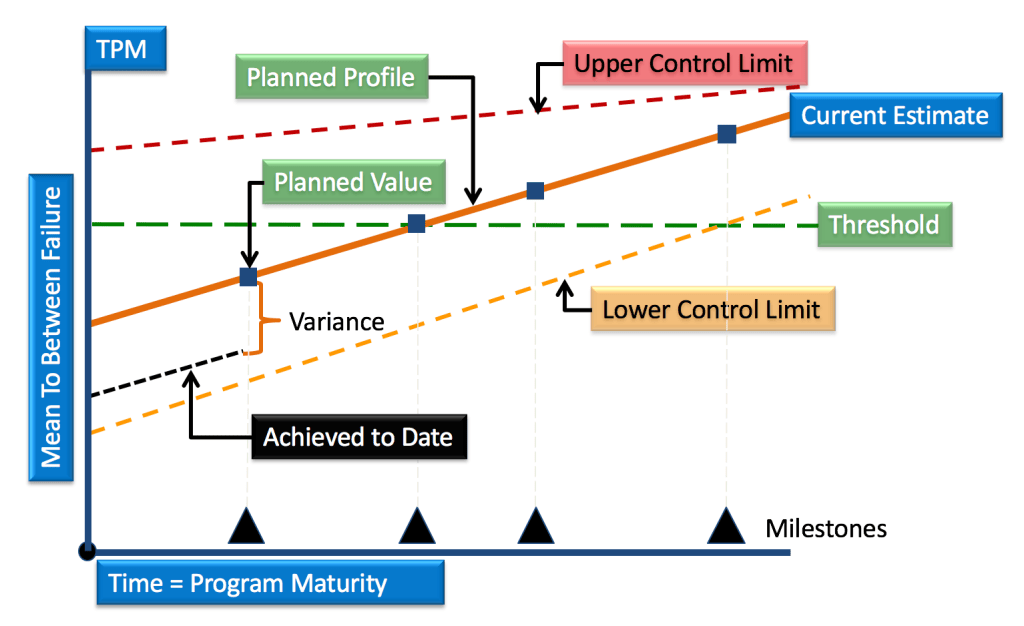
Figure 1 – time-phased planned Technical Performance Measures for Mean Time Between Failure and actual MTBF measures for the product deliverable. Going outside the upper or lower control limit means the product is not compliant, and the project is not on cost and schedule.
Connecting the Dots Between These Measures
With the definitions of MOEs, MOPs, TPMs, and KPPs, let look at an example of how they’re related.
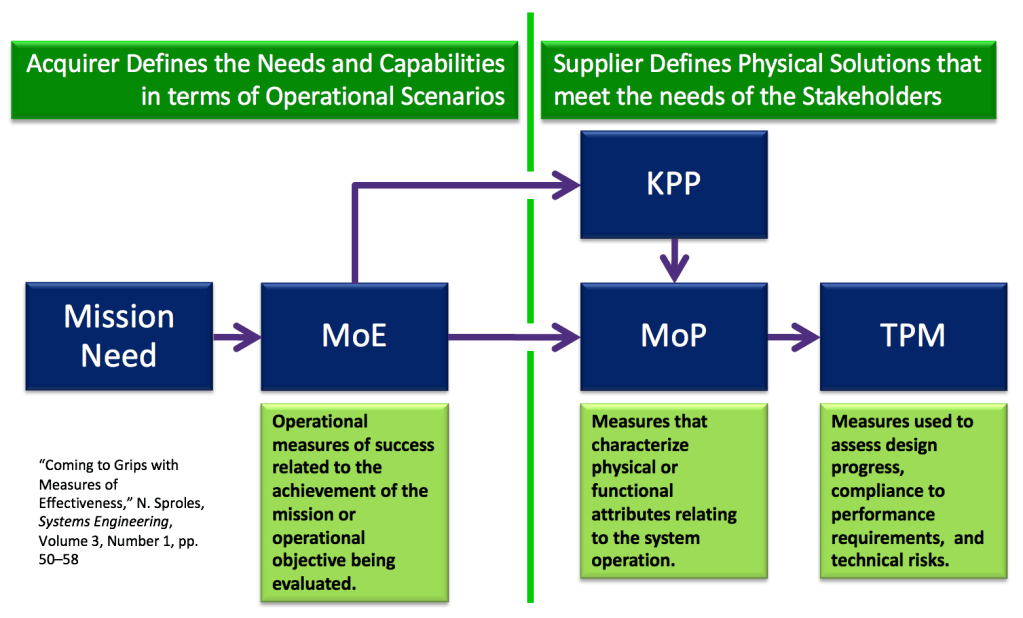
Figure 2 – The Measures of Effectiveness are derived from the Business or Mission need. Key Performance Parameters and Measures of Performance describe how the project’s deliverables fulfill those Effectiveness goals. The Technical Performance Measures describe the engineering attributes of the product or services needed to deliver performance and effectiveness.
A working example of each measure of Done. In this example, the Mission is to deploy a public service system. The local government is concerned about controlling disturbances, mitigating crime, and having forensic video and sound evidence for legal purposes
The county desires to procure a surveillance system with cameras and sound devices at strategic locations, send the data feeds via wireless technology, and monitor, store and retrieve selected incidents.
The government wants near “real-time” response and desires video quality such that they can distinguish facial features and read license plates within 20 feet from the camera
It also wants the system to alert operators when there is evidence of a disturbance
It wants equipment that will allow them to store five years’ worth of data feeds collected 24/7
The government submitted a Request for Proposal (RFP) to procure, install, test, and train personnel. The government has set aside a budget of $40M and wants the system operational within 18 months.
How Do We Know When We Are DONE with the Project?
As the project manager, your immediate job is to develop a “good” WBS, then determine the system’s Measure of Effectiveness (MOE). Select appropriate Technical Performance Measures (TPM) and use them to inform or drive reported cost and schedule progress. Your next job is to assure the government, your customer, that cost and schedule progress will align with measured technical progress.
But that is far from sufficient for project success. Each Measure of Effectiveness, Measure of Performance, Technical Performance Measure, and Key Performance Parameter must be made as planned. That, along with the cost and schedule performance measures, risk-reduction measures, and any other meaningful measures used to inform decision-makers, is part of the description of Done.
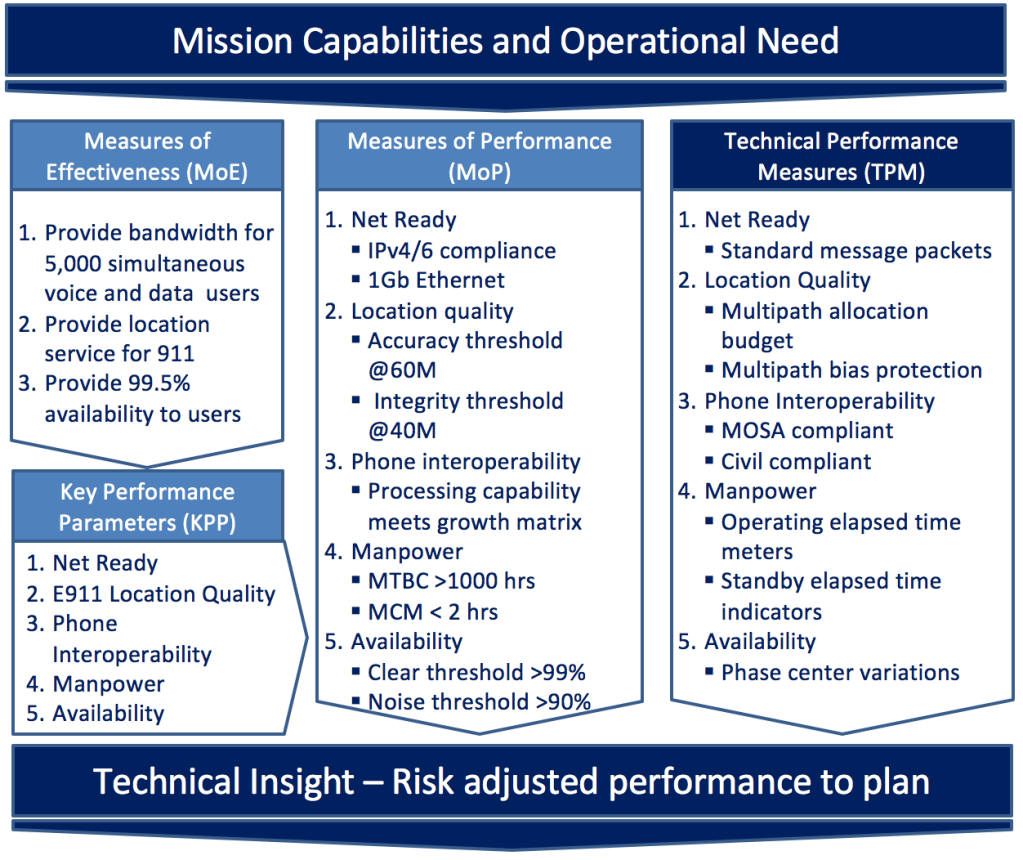
Figure 3 – MOE, MOP, and TPM for a public safety surveillance system to detect disturbances on neighborhoods using audio and video systems as well as emergency 911 dispatching. When these measures are met, the provided system if considered DONE.
Conclusion
Cost and schedule compliance alone is necessary but not sufficient for project success. The product and the processes that produce it must comply with the measures in Figure 2 for each critical deliverable.
Otherwise, the resulting product or service will not meet the customer’s needs.
[1] Making the Impossible Possible: Leading the Extraordinary Performance, The Rocky Flats Story: Lessons from the Cleanup of America’s Most Dangerous Weapons Plant, Kim Cameron and Marc Lavine.


Leave a Reply