Complexity science is an interdisciplinary field that investigates how the individual parts of a system—whether neurons, people, or lines of code—interact to create collective behaviors that cannot be predicted from those parts in isolation. While traditional science often uses reductionism to break things down into their simplest components, complexity science focuses on synthesis and the dynamic relationships between those components. It seeks to answer how order arises from randomness and how systems adapt to changing environments.
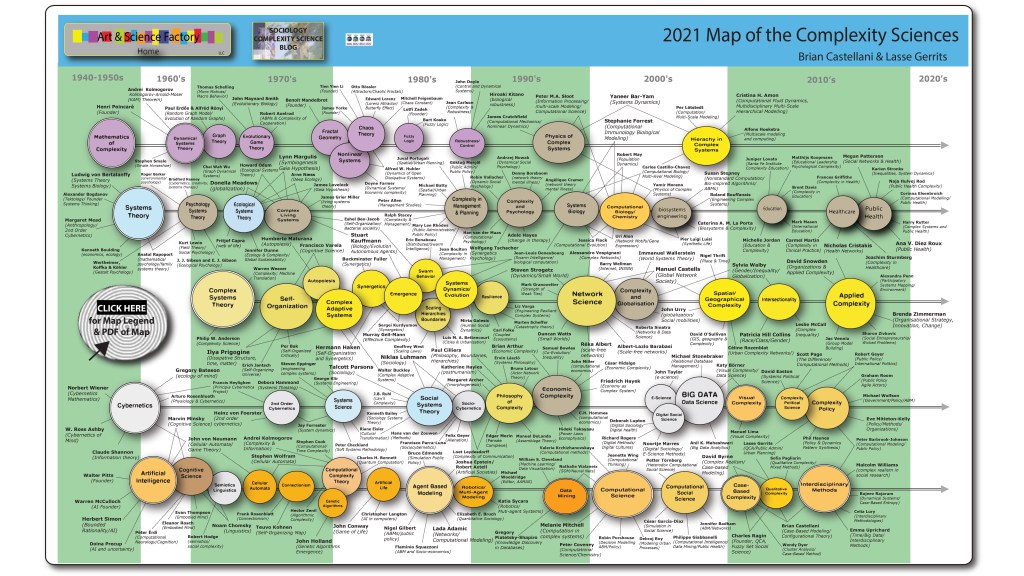
The map of complexity science is not a single set of boundaries but rather a vibrant, interconnected ecosystem of diverse disciplines seeking to understand how collective behaviors emerge from simple interactions. At its core, it bridges the gap between the physical, biological, and social sciences by focusing on complex adaptive systems—networks where the “whole” is significantly different from the sum of its parts. This map spans from the abstract mathematical foundations of chaos theory and information theory to the practical dynamics of network science, game theory, and agent-based modeling. By navigating this terrain, researchers can identify universal patterns—such as self-organization, nonlinearity, and feedback loops—that govern everything from the firing of neurons in the brain and the volatility of global markets to the resilient structures of ecosystems and the spread of social movements.
The map of complexity sciences within the systems engineering domain illustrates the crucial evolution from traditional, reductionist engineering methodologies toward holistic frameworks designed to handle highly interconnected systems. Historically, systems engineering relied on linear, predictable lifecycle models (like the classic V-model) to manage complicated, large-scale projects. However, as engineered systems grew to include vast software networks, human-in-the-loop interactions, and global infrastructures, the map reflects the necessary integration of concepts like cybernetics, system dynamics, and chaos theory. This shift acknowledges that modern engineered systems exhibit emergence—where the dynamic interactions of individual components produce unpredictable, system-wide behaviors that cannot be effectively managed by simply breaking the system down into isolated parts.
This conceptual map highlights the branches where complexity science directly informs advanced engineering practices, such as System of Systems (SoS) engineering, Complex Adaptive Systems (CAS), and Model-Based Systems Engineering (MBSE). These areas represent a paradigm shift in which engineers use network science, agent-based modeling, and adaptive feedback loops to design for resilience rather than rigid control. By embracing the principles outlined in the complexity map, modern systems engineers focus on creating adaptable architectures that can self-organize and survive in volatile environments, effectively bridging the gap between predictable mechanics and the unpredictable reality of modern sociotechnical systems.
The Shift from Complicated to Complexity
• Emergence: This occurs when a system exhibits properties that its individual members do not possess. For example, a single water molecule isn’t “wet,” but a billion of them together create the property of wetness.
• Non-linearity: In complex systems, small changes can lead to massive effects (the “Butterfly Effect”), and large inputs might result in very little change.
• Self-Organization: Without a central leader or “master blueprint,” components can organize themselves into sophisticated patterns, much like a flock of birds or a school of fish.
• Adaptation: Complex adaptive systems (CAS) learn and change based on experience. This is visible in everything from the evolution of the human immune system to the fluctuations of the global stock market.
The four primary deliverables for this complexity science are the following:
- System map — Before you can manage a complex system, you have to see it. A system map charts agents, feedback loops, non-linear interactions, and emergent behaviors across the full system boundary. This isn’t a simple org chart or process diagram—it captures where leverage points exist and how a small intervention can cascade into large-scale change (or dysfunction).
- Adaptive strategy — In complex environments, a rigid multi-year plan is a liability. The deliverable here is a portfolio of options: small bets, reversible moves, and pre-defined decision rules that tell the organization when to pivot, amplify, or abandon a path. This draws from Cynefin and real options theory—strategy becomes a living document, not a roadmap.
- Sensing framework—Complexity surprises those who aren’t watching. A sensing framework institutionalizes continuous horizon scanning—weak signal detection, near-miss reporting, and metrics tuned to spot phase transitions before they arrive. The goal is to shorten the gap between “something is changing” and “we know something is changing.”
- Resilience architecture—The final deliverable shifts the question from “How do we prevent failure?” to “How do we survive and recover from it?” This means designing in redundancy, modularity (so failures don’t cascade), and rehearsed recovery protocols. A resilient system can absorb shocks, reorganize, and maintain core function—it doesn’t just resist stress; it bounces forward.
 Herding Cats
Leave a comment